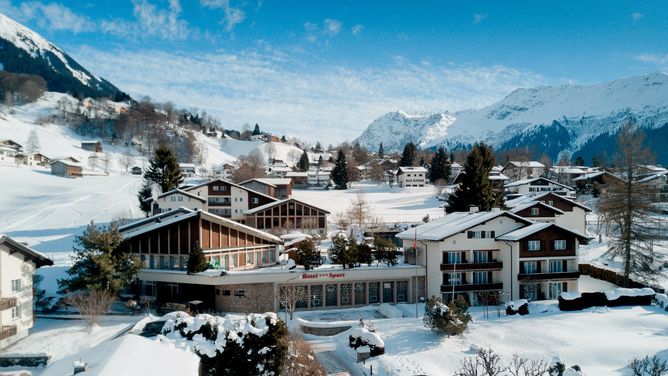
The short answer: The prime months are February and March, with lift passes from around €950 per person per week (including 6-day Davos/Klosters ski pass). The ski area tops out at 2,844 m and the base sits at 1,560 m. Average February temperatures on the mountain range from -8 °C to -2 °C. From London Heathrow to Zurich takes roughly 2 hours by plane, followed by a 2.5-hour train ride directly to Davos Platz.
Which red runs should advanced skiers prioritise in Davos/Klosters?
The Parsenn sector is the heart of the advanced red-run network. Start with the long red runs from Weissfluhjoch (2,844 m) down to Küblis (810 m), a continuous descent of over 2,000 vertical metres that is one of the longest prepared runs in the Alps. The Wolfgang red run connects Davos with the Parsenn area and rewards carvers with consistent gradient and good grooming. Red runs in the Jakobshorn sector, above Davos Dorf, offer a different character: shorter, punchier, and often less crowded than Parsenn on peak days.
| Run | Sector | Top altitude (m) | Bottom altitude (m) | Vertical drop (m) | Length (km) |
|---|---|---|---|---|---|
| Parsenn to Küblis | Parsenn | 2,844 | 810 | 2,034 | 12 |
| Parsenn to Saas | Parsenn | 2,844 | 1,560 | 1,284 | 9 |
| Meierhofer Tälli | Parsenn | 2,660 | 2,060 | 600 | 3.5 |
| Jakobshorn Nord | Jakobshorn | 2,590 | 1,560 | 1,030 | 5.2 |
| Wolfgang red | Parsenn | 1,840 | 1,560 | 280 | 2.1 |
Conditions hold best between late January and mid-March when snowpack on the upper Parsenn plateau is most stable.
What makes the black runs in Davos/Klosters genuinely challenging?
The Gotschna Hang above Klosters is the benchmark black run in the area: a wide open fall-line pitch that becomes heavily mogulled by mid-season and rarely sees machine grooming after the first few days of the season. The Wang run from Parsennhütte is another standout, with sections exceeding 40 degrees and a narrow traverse exit that demands precise technique. The Madrisa area above Klosters Dorf adds off-piste potential on marked freeride itineraries that sit between piste and backcountry.
| Run | Difficulty | Groomed | Avg gradient (°) | Notes |
|---|---|---|---|---|
| Gotschna Hang | Black | Rarely | 35-40 | Classic mogul field by February |
| Wang | Black | No | 38-42 | Narrow lower exit, requires experience |
| Drostobel | Black | Partially | 30-35 | Often icy in cold spells |
| Parsenn Derby course | Black | Race only | 28-36 | Historic downhill route, open outside race days |
| Madrisa itineraire | Freeride itinerary | No | 32-38 | Uncontrolled, avalanche transceiver recommended |
A local mountain guide costs roughly €300 to €450 per day for a private group and is worth considering for the Madrisa itinerary routes or for accessing off-piste lines safely.
How much does a week of advanced skiing in Davos/Klosters cost in 2026/2027?
Costs vary significantly depending on travel timing and accommodation choice. A realistic budget for a solid week in peak season (first two weeks of February) looks like this:
| Item | Budget option (€ pp) | Mid-range (€ pp) | Notes |
|---|---|---|---|
| Return flights (London to Zurich) | 120 | 280 | Book before June for best fares |
| Train Zurich to Davos return | 80 | 80 | Fixed Swiss rail price |
| 6-day Davos/Klosters ski pass | 370 | 370 | Fixed resort price for 2026/27 season |
| Accommodation (7 nights) | 380 | 820 | Apartment vs. hotel half-board |
| Equipment hire | 140 | 220 | Basic carving vs. performance set |
| Food and extras | 200 | 400 | Self-catering vs. eating out daily |
| Total | 1,290 | 2,170 | Per person, sharing |
Early season weeks in December or late-season April weeks can cut accommodation costs by 20 to 35 percent, though snow on the lower black runs is less guaranteed outside the core February to March window.
For a full overview of ski destinations matching your level, visit our complete guide to wintersport.
Frequently asked questions
What is the best month to ski the black runs in Davos/Klosters?
February and March offer the most reliable snow conditions on the higher black runs, with base depths typically between 80 cm and 150 cm and plenty of daylight hours for full-day skiing.
How difficult are the black runs in Davos/Klosters compared to other Swiss resorts?
The blacks in Davos/Klosters, such as the Gotschna Hang and the Parsenn Derby course, are genuinely steep and often groomed only partially, making them suitable for confident advanced skiers rather than intermediates pushing their limits.
What altitude do the ski areas in Davos/Klosters reach?
The highest point is the Weissfluhjoch at 2,844 m above sea level, with the valley base in Davos sitting at around 1,560 m, giving a solid vertical drop for long descents.